IgniteIt · Cannabis Capital ConferenceMIAMI 2027March 24–26 · The Diplomat Beach Resort, Hollywood FL

- Economics •
- 4 min read
U.S. Cannabis Growth Is Coming Back in 2026—But the Easy Money Is Gone

Whitney Economics forecasts a return to growth after 2025’s decline, but oversupply, falling prices, and weaker state performance show the legal market has entered a harsher new phase.
After a bruising 2025, the legal cannabis industry is expected to resume growth in 2026. The problem is that the recovery looks more like normalization than resurgence.
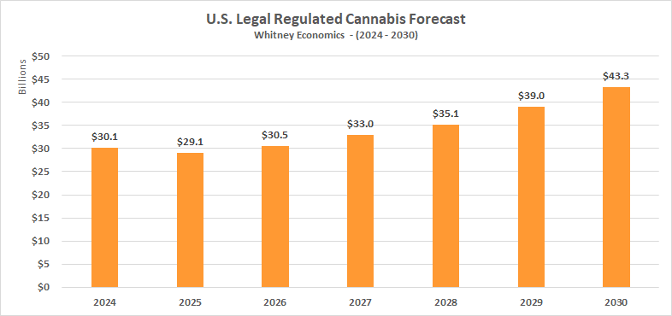
Whitney Economics projects U.S. legal cannabis revenue will reach $30.5 billion in 2026, up 4.9% from 2025, after what the firm says was the first year-over-year revenue decline in the history of the regulated U.S. market. From there, the market is expected to climb steadily to $43.3 billion by 2030.
That headline number matters, but the more important story is what sits beneath it: the cannabis industry is no longer being driven primarily by rapid consumer conversion into legal channels. It is now being constrained by a much more traditional economic force: price compression.
For years, cannabis operators and policymakers could count on expansion to mask structural weakness. New state launches, store openings, and a growing legal customer base kept total revenue moving higher even as prices softened. That dynamic is changing. As markets mature, wholesale and retail prices continue to fall, and that decline is beginning to outweigh gains from volume and participation.
Whitney Economics founder and chief economist Beau Whitney argues that this is not a temporary anomaly. It is a sign that the industry is entering a new phase.
The firm’s forecast shows the market dipping from $30.1 billion in 2024 to $29.1 billion in 2025, before turning positive again in 2026. Growth then remains modest by the standards the industry once expected: $33.0 billion in 2027, $35.1 billion in 2028, $39.0 billion in 2029, and $43.3 billion in 2030.
That is still growth. It just is not the kind of growth cannabis operators, investors, and tax-hungry states had become accustomed to.
The second chart may be even more revealing. In 2025, 24 states are expected to post cannabis revenue declines, while only 15 will see increases. Compare that with 2021, when just two states saw declines and 33 posted gains, and the direction of travel becomes obvious. The legal market is no longer lifting all boats.
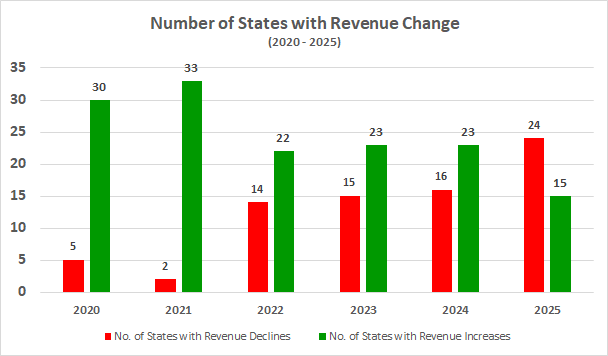
The reasons are straightforward. New York and Ohio helped soften the national decline by expanding consumer access and adding retail capacity. But those bright spots were not enough to offset broader weakness across mature markets where oversupply continues to crush pricing.
That has major implications beyond operator margins.
For states, the message is uncomfortable: cannabis tax revenue can no longer be modeled as a straight line up. If retail prices are falling, tax collections will come under pressure too. And simply raising taxes to compensate could backfire by pushing more consumers toward the illicit market or reducing demand altogether.
For operators, the lesson is equally stark. Strong unit sales do not automatically translate into stronger revenue. Consumers are still buying cannabis, but they are behaving differently than they did during and immediately after the Covid era. Basket sizes are tightening. Spending is becoming more selective. Savings from lower cannabis prices are being redirected to other household expenses.
In other words, cannabis is starting to behave like a mature consumer category rather than a high-growth anomaly.
That shift should force a broader rethink across the industry. If the legal market is going to keep growing while prices continue to deflate, the next stage of expansion will likely depend less on licensing more dispensaries and more on making legal access easier, more convenient, and more competitive. That could mean new distribution models, including sales channels beyond the traditional dispensary footprint.
The bigger takeaway from Whitney Economics’ latest forecast is not simply that growth returns in 2026. It is that the terms of growth have changed.
The era of easy expansion appears to be ending. What comes next is a slower, more disciplined market where single-digit growth is the norm, pricing pressure is constant, and success depends less on riding the wave than on surviving it.
For an industry that spent a decade selling the promise of exponential upside, that may be the most important forecast of all.
Photo by Daniel Öberg on Unsplash

Javier Hasse
March 25, 2026Co-Founder of IgniteIt, Editor-in-Chief of High Times and Forbes senior contributor. 2026 International Journalist of the Year.