Don't Miss The World's #1 Executive Networking Event"

What Investors Miss When Evaluating Cannabis Cultivators
Revenue and EBITDA can tell investors how a cannabis cultivation company performed. Sean Oganesyan argues they don’t necessarily reveal whether those results can be repeated.
Oganesyan, founder of Surreal Yields, has worked with cultivation operations ranging from smaller facilities to large, multi-building projects. His approach focuses on something investors don’t always see on an income statement: whether a cultivation business can repeatedly produce sellable flower at a predictable cost.
That means looking beyond headline yield and asking about cost per pound, crop turns, batch variability, labor efficiency, environmental deviations, and what happens when a company’s best cultivator walks out the door.
In this Q&A with IgniteIt, Oganesyan explains the five cultivation KPIs he would examine before investing, why price compression exposed operational weaknesses that were already there, and why he believes repeatability—not square footage, genetics, or expensive equipment—will become one of the industry’s most important competitive advantages.
Investors often focus on revenue and EBITDA. What operational indicators do you look at first to determine whether a cultivation business is fundamentally healthy?
Revenue and EBITDA tell me what happened. They don’t necessarily tell me whether the operation is healthy or whether those results are repeatable.
The first thing I want to understand is consistency. Show me the last 12 months of production by room and by harvest. I want to see yield, cycle time, packageable product, labor, crop loss, environmental deviations, and what it actually cost to produce each pound.
Anybody can show me one great harvest. Show me you can repeat it.
I also look at how dependent the operation is on specific individuals. If the head cultivator disappears tomorrow and the facility can’t reproduce the same result, that’s operational risk. A healthy company has institutional knowledge—SOPs, training, data, accountability, and systems—not knowledge trapped inside one person’s head.
Ultimately, I’m looking for predictability: predictable production, predictable quality, predictable costs, and predictable execution.
That’s what turns cultivation into a business.
What are the biggest operational mistakes investors and management teams overlook when evaluating cannabis cultivators?
One of the biggest mistakes is confusing expensive infrastructure with a good operation.
I’ve walked into facilities with millions of dollars of equipment, beautiful rooms, good genetics, sophisticated lighting and HVAC—and they’re still losing money.
Equipment doesn’t fix a broken system.
I look at how the facility was designed around workflow: how plants move, how employees move, air distribution, irrigation, maintenance, sanitation, and IPM. How quickly are problems identified, and who is accountable for fixing them?
The other major mistake is evaluating everything in isolation. Cultivation, HVAC, labor, irrigation, and finance aren’t separate businesses. They’re one interconnected system.
A cultivation problem can actually be an HVAC problem. An HVAC problem can become a crop-loss problem. Crop loss becomes a cost-per-pound problem, and suddenly management thinks it has a pricing problem.
That’s why we’ve always operated proactively: You anticipate problems before problems become problems.
If you could review only five KPIs before investing in a cultivation company, what would they be?
I’d want five things:
- True cost per pound of packageable flower. Not total biomass. What does it actually cost to produce product you can sell?
- Packageable yield per light or per square foot. Yield means very little if a large percentage doesn’t become sellable premium product.
- Annual crop turns and cycle consistency. A facility producing three pounds per light six times a year is a very different business from one producing comparable quality seven or more times.
- Batch-to-batch variability and crop-loss rate. The average can hide a lot. I want to know the spread between your best and worst rooms and why it exists.
- Labor efficiency. How many labor hours and dollars are required to produce each pound, and does that improve or deteriorate as the company scales?
Those five numbers tell me a tremendous amount about management.
But I wouldn’t just ask for today’s number. I’d ask for the trend.
A KPI without history is a photograph. I want the movie.
Many operators blame price compression for weak financial performance. How much of today’s margin pressure is market-driven versus operational?
Price compression is real. I’ve lived through it.
In California, we watched indoor wholesale pricing fall from around $5,000 per pound to periods when product was trading near $500. You can’t pretend the market doesn’t matter.
But price compression also exposed operational problems that were already there.
When margins were enormous, inefficiency could hide inside the price of the product. Excess labor, poor yields, long cycles, crop failures, expensive inputs, inefficient facilities—you could make mistakes and still make money.
When prices compressed, the tide went out.
At HDO, for example, production was approximately 2.1 pounds per light when we began working with the operation. Through cultivation optimization, environmental improvements, technology, and operational discipline, that increased to approximately 3.3 pounds per light, while production costs were reduced and product quality improved enough to command roughly a 20% premium over average wholesale indoor flower in its market.
Same difficult market.
Different operating system.
So I don’t believe operators can simply blame the market. You can’t control wholesale pricing. You can control how efficiently and consistently you produce into that market.
What separates the highest-performing cultivation facilities from the rest?
Discipline and repeatability.
The best facilities aren’t necessarily the ones with the most sophisticated technology or the most famous genetics. They’re the facilities where everybody understands the standard and executes it consistently.
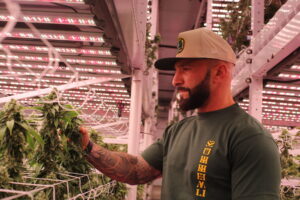
There are documented SOPs. Employees are trained against those SOPs. Environmental parameters are measured. Maintenance is preventative rather than reactive. Labor has accountability. Management looks at data instead of relying entirely on instinct.
And leadership matters tremendously.
When something goes wrong, weak organizations look for somebody to blame. Strong organizations ask why the system allowed it to happen and how they prevent it from happening again.
I’ve worked on operations ranging from relatively small facilities to massive multi-building projects, and that principle doesn’t change.
Scale doesn’t create discipline. Discipline allows you to scale.
If two cultivators have similar financial results, how can an investor identify the stronger long-term business?
I’d spend less time asking what they’re producing today and more time asking how they’re producing it.
I’d ask management to walk me through the last failed crop. What happened? When did they identify it? What did it cost? What changed afterward?
Then I’d ask what happens if their best cultivator leaves tomorrow.
Show me the SOPs. Show me the training program. Show me maintenance records. Show me room-by-room production history. Show me environmental deviations. Show me labor utilization. Show me the difference between the best-performing room and the worst-performing room.
I’d also ask them to explain their cost per pound without having the CFO answer for them.
If cultivation leadership doesn’t understand the economics of what they’re producing, that’s a problem.
The stronger company isn’t necessarily the company with the highest number today. It’s the company whose results are least dependent on luck, one individual, or perfect market conditions.
That’s the business I’d invest in.
What operational capabilities will define the cannabis industry’s winners over the next five years?
The winners will combine systems, data, automation, AI, and leadership—but in that order.
There’s a tendency in cannabis to believe the next technology will solve the industry’s problems. AI isn’t going to fix a poorly designed facility. Automation isn’t going to fix a bad SOP. Data doesn’t help if nobody knows what decisions to make with it.
Technology should multiply a good operating system.
I’ve been integrating environmental controls, irrigation, fertigation, CO₂, HVAC, and facility data for years because the objective has always been to remove unnecessary variability and give operators better information.
AI takes that much further. Eventually, these facilities shouldn’t simply tell us what happened. They should help identify what’s about to happen.
That’s where I believe cultivation is headed: predictive operations.
But there’s another capability I think investors underestimate—developing people.
A truly scalable organization doesn’t just grow plants. It grows leaders who understand the system well enough to operate it, improve it, and teach it to the next person.
The industry’s winners won’t necessarily own the largest facilities.
They’ll own the most repeatable operating systems.
The real moat in cannabis isn’t square footage, genetics, or equipment. It’s the ability to produce the same quality, at a predictable cost, over and over again, and then reproduce that system.

Nicolas Jose Rodriguez
August 25, 2026