IgniteIt · Cannabis Capital ConferenceMIAMI 2027March 24–26 · The Diplomat Beach Resort, Hollywood FL

Cannabis Lending Gets A New Tool For Verified Operational Data

Cannabis lenders still face a basic problem: they often have no reliable way to verify the numbers operators give them. NCS Analytics says its new platform, NCS Thea, is designed to help close that gap by turning data from state-mandated compliance systems into a structured risk signal that lenders can use within their existing underwriting workflows.

A Structural Blind Spot
During an interview with IgniteIt, NCS Analytics CEO Adam Crabtree said the idea for Thea grew out of what the company was already seeing in its regulatory work.
“We already have a pretty large footprint in the cannabis space,” Crabtree said. “With a background in banking, understanding that lending just isn’t happening in the cannabis space—or it’s on a very small scale—we’re seeing commercial real estate and things like that, but still mainly a lot of hard money for folks that need to find capital. So trying to address that, and also being able to see how little of it’s out there, but seeing the want of both sides to be able to figure out a way to do it.”
The blind spot, as he describes it, is simple: lenders evaluating cannabis operators often have no independent way to verify the numbers they’re given. No electronic payment trails. No third-party validation. No equivalent to the year-end processor records that help underwrite many other retail businesses.
Rebuilding the Missing Validation Layer
Crabtree said Thea’s value is not in a single metric, but in the depth of the underlying data.
“The level of detail that we’re able to rebuild those financials is what really gives them the most comfort,” he said. “It’s not a single number. It’s every single sale they’ve done over the last couple of years and things like that.”
That granularity, he argues, mirrors the difference between what a borrower tells a bank and what they tell regulators.
“In my banker days, there were more than a few occasions that those weren’t the same,” he said. “Banks want to see what you told the regulators, not just what you’re telling your banker.”
Crabtree also said NCS had the model independently reviewed by a major accounting firm, which he said rebuilt Thea and assessed both its conceptual and functional design so lenders could evaluate it with the same scrutiny they apply to other risk tools.
What NCS Thea Does
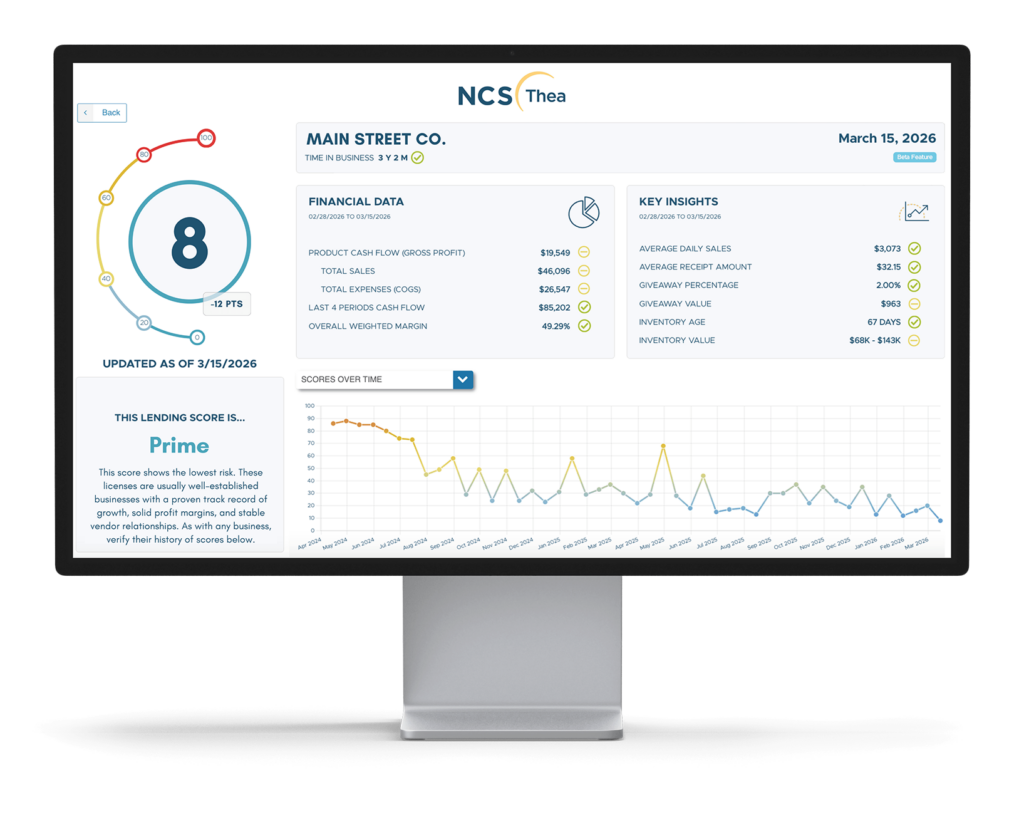
The platform aggregates and analyzes a range of operational and compliance indicators, including:
- Regulatory compliance status
- Inventory health and velocity
- Vendor stability
- Cash-flow patterns
- Margin trends
- Transaction-level activity
From there, Thea generates a composite score and detailed operational profile that lenders can use at multiple points in the credit process, from pre-screening to underwriting support, risk-based pricing and ongoing portfolio monitoring.
Why It Matters
The cannabis industry’s lack of access to traditional credit remains one of its most persistent structural barriers. Hard-money loans and double-digit interest rates are still common. Crabtree said he hopes verified operational data can begin to shift that dynamic.
“We hope it’s going to greatly improve it—at responsible rates,” he said.
Chris Van Dyck, a partner at Cogent Law, framed the stakes similarly in the NCS Analytics announcement, saying access to “verified, auditable operational data” could help financial institutions evaluate cannabis lending opportunities within existing regulatory frameworks.
If Thea performs as intended, it could give lenders a clearer view of how cannabis businesses actually operate. That would not solve the industry’s broader capital access problems on its own, but it could make underwriting feel less opaque in a sector where opacity has long driven both caution and cost.

A.J. Herrington
April 7, 2026Cannabis journalist whose reporting on policy, business, science and culture has appeared in Forbes, High Times, Cannabis Now and HEMP.